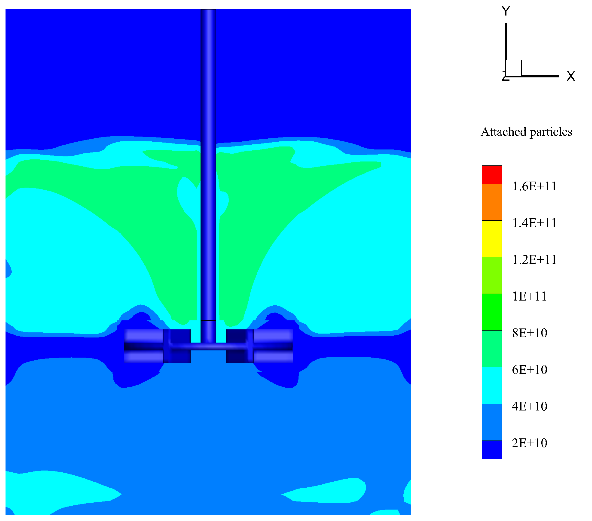
This report focuses on the validation of a numerical tool developed for simulating the flotation process using Computational Fluid Dynamics (CFD). The primary objective is to evaluate the accuracy of this tool in modeling multiphase flow dynamics, including particle-bubble interactions in the flotation process. First, the modeling of flotation kinetics and particle-bubble interactions in the pulp zone are examined, followed by the use of the Rushton turbine as a benchmark case for assessing the numerical tool. Simulations were carried out using the Fluent software with a multiphase Eulerian solver, incorporating turbulence models and appropriate boundary conditions. The results demonstrate that the developed tool effectively reproduces physical phenomena such as fluid mixing, aeration, and particle attachment to bubbles. Additionally, the numerical tool shows high accuracy in simulating the complex flow dynamics and flotation-related processes, aligning well with expected standards.
Flotation is a widely used separation technique in industries such as mining, wastewater treatment, and metallurgy, relying on the interaction between gas bubbles and solid particles for the efficient separation of materials. Accurate modeling of this process is critical for optimizing performance and reducing operational costs. Computational Fluid Dynamics (CFD) has emerged as a powerful tool for simulating the complex multiphase flows involved in flotation, enabling detailed analysis of particle-bubble interactions, fluid dynamics, and system kinetics. This study aims to validate a newly developed numerical tool designed for simulating flotation processes, with a focus on assessing its accuracy in replicating key physical phenomena such as fluid mixing, aeration, and particle attachment. Using the Fluent software and a multiphase Eulerian solver, the Rushton turbine was employed as a benchmark case to evaluate the tool's performance, ensuring its reliability for future industrial applications.
In this study, the Fluent software is utilized for simulating the flotation process. An Eulerian multiphase solver is employed to model the interactions between solid particles, gas bubbles, and the liquid phase. The Navier-Stokes equations, along with phase transfer equations and energy equations, are used to simulate fluid dynamics. For turbulence modeling, the k-e RNG model is implemented, which is well-suited for predicting turbulent flows in regions close to the impeller.
The system geometry consists of a mixing tank with a Rushton turbine impeller. The geometry specifications are as follows:
These geometric settings and boundary conditions are implemented to ensure accuracy in the simulation and correct reproduction of the physical phenomena involved in the flotation process.
This study focuses on simulating the flotation process using Computational Fluid Dynamics (CFD) with Fluent software. The Eulerian multiphase solver was employed to model the interactions between solid particles, gas bubbles, and the liquid phase. The Navier-Stokes equations and turbulence modeling using the k-e RNG model were utilized to enhance the accuracy of the simulation.
The simulation yielded several important findings:
This study demonstrates that the developed numerical tool can accurately simulate the complex dynamics of flotation processes, providing valuable insights for optimizing industrial applications.